If you already run proxies, an antidetect browser, and a stack of isolated profiles, buying an established account is the next logical step — and the one most guides skip over. An anonymous, well-configured browser profile still needs an identity to log into, and a brand-new account created inside it is exactly the profile platforms trust least. That is why marketers, media buyers, and multi-accounting operators buy aged and phone-verified accounts: to start from a footprint the platform already accepts rather than a cold one it scrutinizes. The account marketplace exists precisely for this. But choosing where to buy social media accounts is the real risk variable — platforms differ enormously in how they source accounts, whether they hold funds in escrow, and what happens when an account fails. This is a neutral review of where to buy and sell, and what to check before you pay.
A quantified look at the buy side: what age is actually worth
To put real numbers on the age premium, we logged every in-stock aged Facebook listing on one of the largest seller-aggregator marketplaces in this space (not one of the five reviewed here) — 46 listings in total, captured on 22 August 2026. The pattern is unambiguous. Holding the configuration constant (mixed-geo registration, 2FA included, same seller line), the entry price stepped from $1.11 for a 2024-registered account to $1.20 for 2023, $1.68 for 2022, and $2.78 for 2021 — a 2.5× premium for three additional years of age. Registration geography moves prices far more than age does: 2022-registered accounts ranged from $1.68 for mixed-geo stock to $12.95 for US-registered profiles from the same catalog, roughly 7.7 times the floor for the same vintage. Whether the original creation email transfers with the account produced the next-largest gap within any single year.
Across 46 in-stock aged Facebook listings observed on a single marketplace on 22 August 2026, three extra years of account age cost 2.5× more like-for-like — but US registration multiplied the price of the same vintage by up to 7.7×.
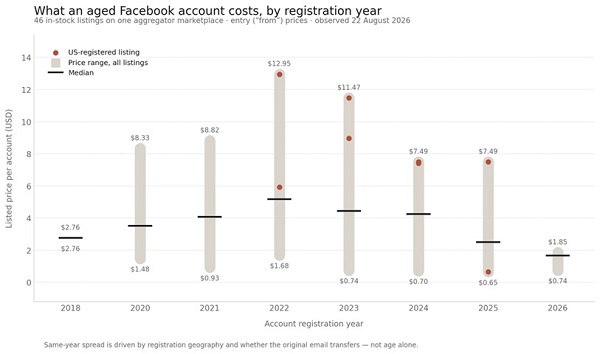
The reason these numbers matter more than any headline price is variance. On a marketplace that aggregates many independent sellers, a batch of ten accounts might arrive with three or four that fail verification — which quietly raises your true cost per working account well above the sticker price. A quantified figure like the one above is the only honest way to compare a cheap-per-unit aggregator against a pricier direct producer or an escrow broker, and it is why the five platforms below were chosen for what they do well rather than for the lowest number on the page.
How we evaluated each marketplace
Every platform below was assessed against the same six criteria, so the comparison is like-for-like rather than a list of sales pitches. Five made the cut because each is the strongest option for a distinct job — follower-attached pages, bulk operational accounts, high-value vetted deals, curated Instagram, and revenue-attached assets — and the article says which job each is for.
- Inventory depth — how many platforms and account types are actually available, and whether stock is consistent or sporadic.
- Vetting and escrow — whether a neutral party holds funds until the account is confirmed, and how sellers are screened.
- Replacement or warranty — what happens when an account fails, and how long the window lasts.
- Payment methods — crypto, card, wire, or e-wallet, and what that implies for your payment footprint.
- Support responsiveness — whether there is a real team behind disputes and replacements.
- Pricing transparency — whether fees and terms are published or hidden until checkout.
Where a platform is weak on a criterion, that appears in its cons — a review that hides the downsides is not a review.
The marketplaces, reviewed
FameSwap Review
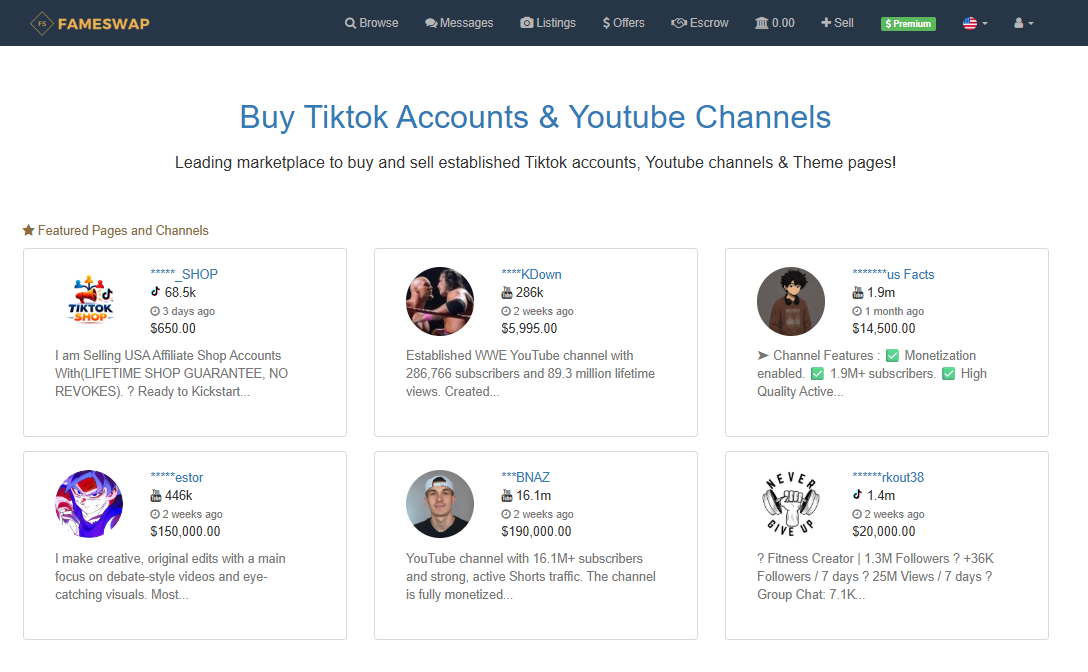
Types of accounts: Instagram, TikTok, YouTube channels, theme pages
Inventory scale: Large, follower-attached listings across niches
Founded: 2013
Payment methods: Crypto (via balance), bank wire
Warranty window: 3-day buyer review inside escrow
FameSwap is the broadest broker for audience-attached accounts — pages and channels that already have followers, not blank operational accounts. Operating since 2013, it has a first-mover position in this niche, predating TikTok itself. It runs a genuine escrow: the buyer funds a FameSwap balance or wires the amount, the seller delivers login details through the platform, and the buyer has three days to confirm the account works before funds release. As of August 2026, FameSwap’s published escrow fee is 5% of the offer price or a $50 minimum, whichever is greater, on transactions over $100, dropping to 3% for premium subscribers. That $50 floor is the detail worth internalizing: on a $120 sale it swallows a punishing share of the deal.
For Instagram and TikTok, transfers run through login handover, and Instagram accounts must include the original creation email so the buyer can fully secure ownership. That requirement is a quiet quality signal — it forces sellers to prove real control rather than passing a recoverable account.
Pros
- Real escrow with a defined 3-day buyer confirmation window.
- Widest selection of follower-attached pages and channels.
- Original-email requirement on Instagram reduces recovery risk.
- Seller-facing: clear listing flow and 24/7 support for transactions.
Cons
- The $50 minimum fee makes small transactions uneconomical.
- No protection against a seller recovering an account weeks later.
- Wire funding can take days for international buyers.
AccsZone Review
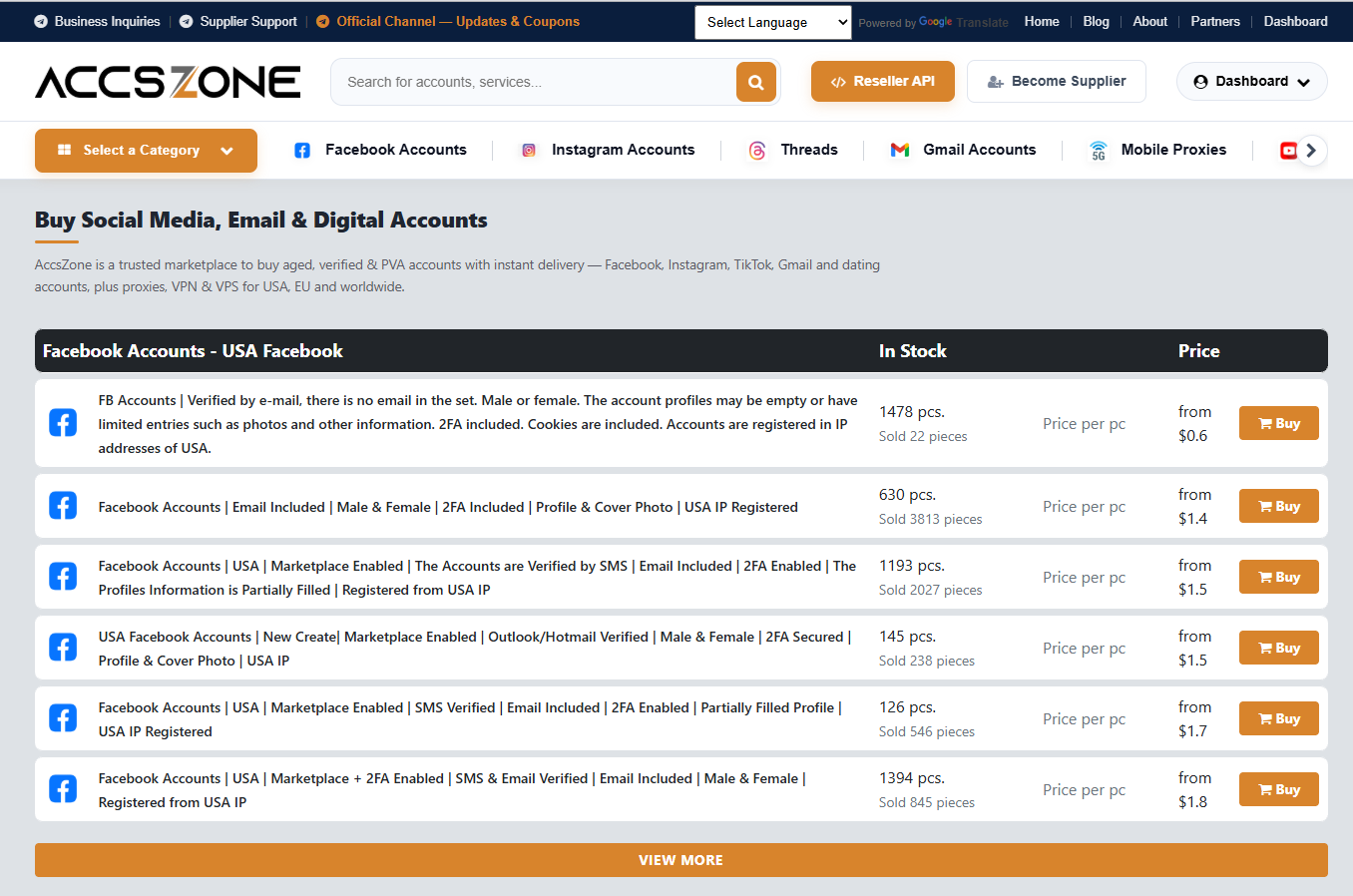
Types of accounts: Facebook, Instagram, Gmail, TikTok, LinkedIn, X, Telegram, Reddit, dating and email — social, email, messaging, dating, finance and services categories
Inventory scale: In-house catalog with registrations across the US, Canada, Europe, UK, Latin America, Asia and Africa
Founded: 2023
Payment methods: Crypto via Cryptomus and NOWPayments
Warranty window: Replacement or refund (as store credit) for accounts that fail before first login; claim within 24 hours of purchase
AccsZone is structurally different from the brokers on this list: rather than aggregating third-party sellers, it produces its own inventory in-house, registering accounts with country-specific IPs, real phone numbers and mobile proxies during creation, and states that origin on the listing. Its lane is operational accounts bought in quantity — the working profiles behind multi-account setups, ad accounts and outreach — rather than a single audience-attached page. For a Whoer.net reader who already thinks in terms of consistent fingerprints and clean IP origin, a stated registration country and IP type is the detail that makes the pre-login check below possible: you can only match an environment to an origin you know. Delivery is automated and immediate after payment.
Because it is a direct producer, there is no buyer-to-buyer escrow. AccsZone’s published terms are narrower and more specific than most: an account that is non-functional or suspended before the initial login is replaced or refunded as store credit, provided the claim is raised within 24 hours of purchase, and a 24/7 human support team handles that directly rather than mediating between strangers. Read that as it is written — the guarantee covers delivery, not what happens after you log in, which is exactly why the pre-login environment check below matters more here than on any escrow platform. Checkout is crypto-focused through Cryptomus and NOWPayments.
Pros
- In-house production means consistent quality and one party responsible for replacements.
- Country-specific IPs, real phone numbers, and mobile proxies at registration.
- Instant automated delivery, suited to bulk and repeat buying.
- Broadest category range on this list — social, email, messaging, dating, finance and services under one storefront.
Cons
- Crypto-focused checkout won’t suit buyers who want PayPal or card rails.
- Direct-producer model means no buyer-to-buyer escrow — the guarantee is delivery-only (pre-login failure, 24-hour claim window), handled in-house.
SWAPD Review
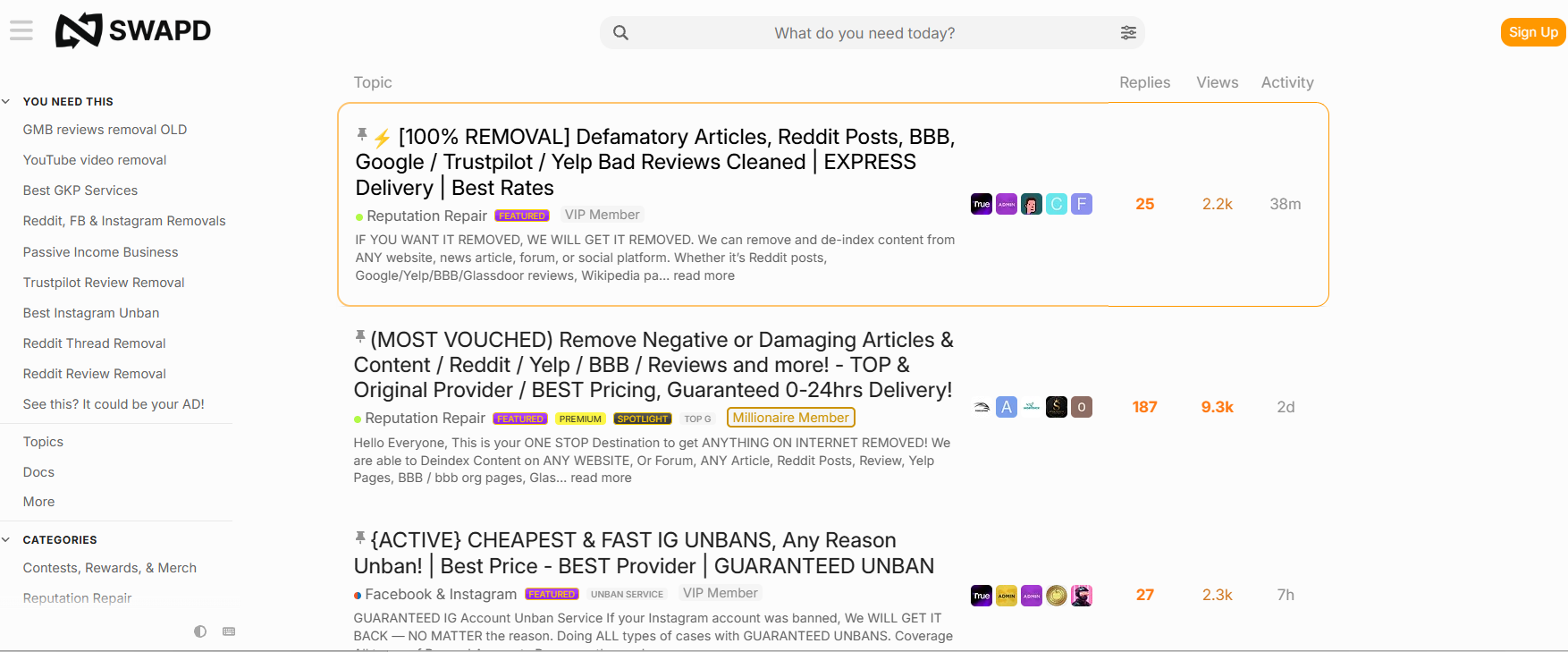
Types of accounts: Social media, digital assets, marketing services
Inventory scale: Curated, higher-value listings; tens of thousands of members
Founded: 2017
Payment methods: Crypto, bank wire, card (tier-dependent)
Warranty window: Merchant-of-record model with human review per deal
SWAPD positions itself as the professional, compliance-heavy end of the market. It operates as the merchant of record for every transaction and enforces AML/KYC identity verification on all members via SumSub — the strongest institutional guardrails on this list. That vetting is the whole pitch: it filters out casual scammers before they can list. As of August 2026, SWAPD’s published fee chart tiers rates by member status and payment method, with a documented minimum SWAPD fee of $35 on transactions under $350, so small deals are proportionally expensive here too.
For a high-value acquisition — a large account or a portfolio — SWAPD’s member vetting and managed-transaction model provide more buyer safety than an open forum. The trade-off is friction: the KYC requirement deters buyers who want to stay anonymous, which for a privacy-minded reader is a genuine consideration, not a footnote.
Pros
- Merchant-of-record model with per-transaction human oversight.
- AML/KYC vetting via SumSub screens out most bad actors.
- Strong fit for high-value, lower-frequency purchases.
- Seller-facing: professional environment with active moderation.
Cons
- Mandatory identity verification conflicts with buyer anonymity.
- $35 minimum fee makes low-value deals inefficient.
- Slower, more deliberate process than automated storefronts.
SocialTradia Review
Types of accounts: Instagram (primary), some TikTok
Inventory scale: Curated niche IG accounts, roughly 2K to 100K+ followers
Founded: 2016
Payment methods: Credit card, Wise, wire transfer
Warranty window: 5-business-day money-back if transfer can’t complete
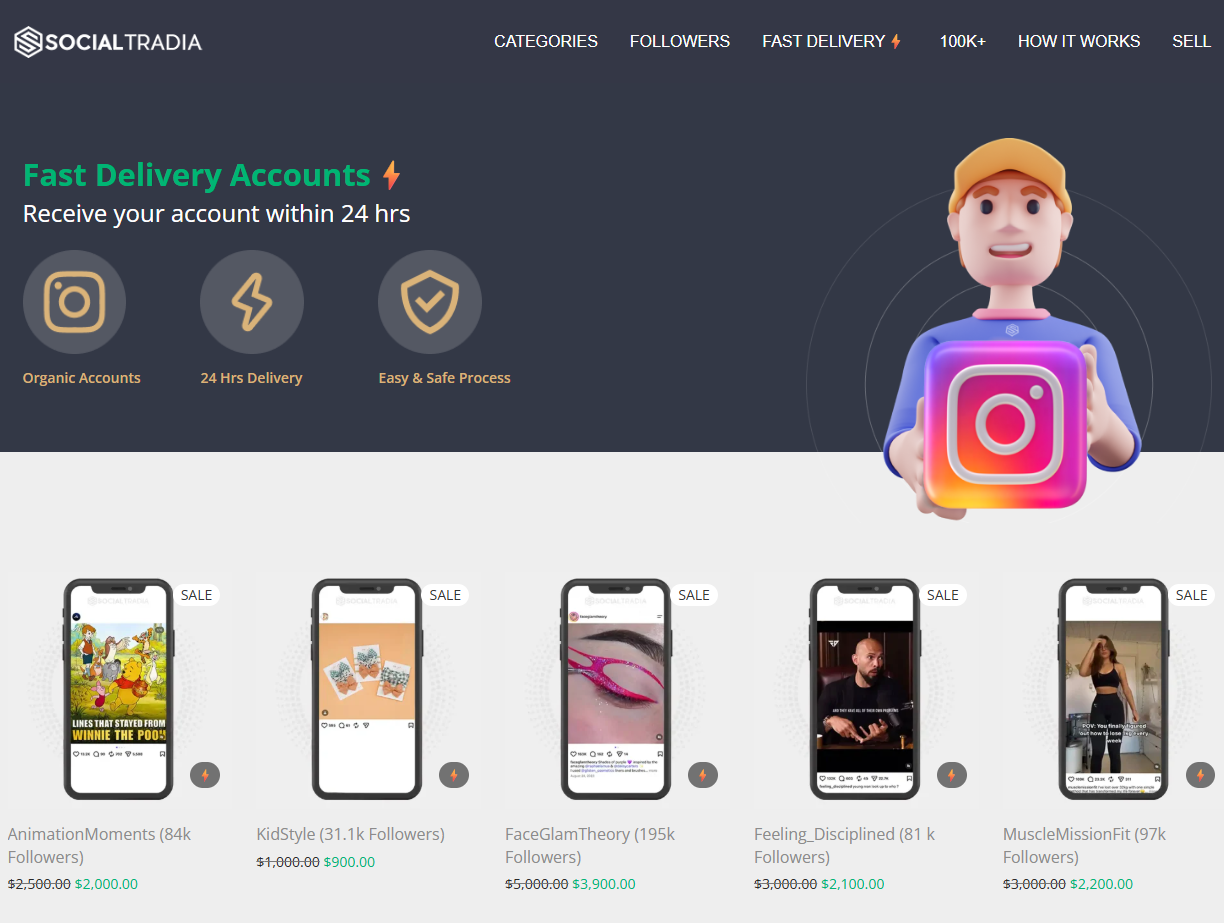
SocialTradia is the specialist for vetted Instagram accounts. Every listing is manually reviewed, sellers must prove ownership before an account is uploaded — which keeps stolen and recovered accounts out — and the platform takes over the account from the seller before releasing payment, so the buyer isn’t relying on trust alone. As of August 2026, its published transaction fee is 10%, paid by the buyer, and it offers a 100% money-back guarantee if a transfer can’t be completed within five business days.
The trade-off is cost and scope: the 10% fee plus curation premium means you pay meaningfully more than a direct seller, and the catalog is narrow — Instagram-first, with limited volume. For a first purchase or a single quality page where escrow protection is worth the premium, it’s a strong choice; for bulk operational accounts it’s the wrong tool.
Pros
- Manual review and mandatory ownership proof on every listing.
- Platform-managed takeover before payment release.
- 5-day money-back guarantee on failed transfers.
- Seller-facing: offline promotion to a real buyer list, 10% fee paid by buyer.
Cons
- 10% fee plus curation premium raises effective cost.
- Narrow scope — Instagram-first, limited volume.
- Not suited to bulk or operational account buying.
Flippa Review
Types of accounts: Websites, apps, social accounts, newsletters, domains
Inventory scale: 10,000+ listings; large registered buyer pool
Founded: 2009
Payment methods: Card, wire, Escrow.com / FlippaPay
Warranty window: Escrow holds funds until transfer confirmed
Flippa is the largest open marketplace for digital assets, and it belongs on this list specifically for accounts attached to a revenue-generating business — a social account bundled with a store, blog, or app rather than a standalone profile. It runs escrow through Escrow.com and its own FlippaPay, holding funds until the asset transfers. As of August 2026, sellers pay a non-refundable listing fee starting around $29 plus a tiered success fee that runs from roughly 10% on sub-$50K deals down to 5% on larger ones; buyers browse and bid free.
The critical caveat is vetting: listings below $50,000 receive no platform verification, self-reported figures are common, and Flippa will not process a dispute once escrow funds are released. For audience-attached or revenue-attached properties with verified financials it’s the deepest pool available; for a bare operational account it’s overkill and the fee structure works against you.
Pros
- Largest buyer pool and widest asset range.
- Escrow by default via Escrow.com and FlippaPay.
- Verified-financial badges on connected listings.
- Best route for revenue-attached social properties.
Cons
- No platform vetting on listings under $50,000.
- No dispute processing once escrow funds are released.
- Non-refundable listing fees plus success fees stack up.
Before your first login: the environment check every marketplace guide skips
Every warranty above ends at roughly the same moment — the first login. From then on, the account’s survival depends on whether the environment you log in from is consistent with the environment it was created in. A bought account carries a history: a registration country, an IP type, a timezone, a language, and on many platforms a browser fingerprint from its earliest sessions. The platform does not know the account changed hands; it only sees whether today’s session contradicts that history. Most first-day bans are not detection of a purchase. They are detection of a mismatch.
Run the check before you enter a password, not after a checkpoint appears. Six things to compare against the listing:
IP country and city vs. registration country. A US-registered account opened from an IP that resolves to another country is the single most common first-login trigger. The listing tells you the registration geo; your IP check tells you where you actually appear.
IP type. Datacenter and hosting ranges are labelled as such in every IP database; residential and mobile ranges are not. An account created on a mobile or residential connection and opened from a hosting IP is a contradiction the platform can read from the first packet.
Timezone and language vs. IP. The browser reports its own timezone and Accept-Language; if the IP says New York and the browser says UTC+7 with a Vietnamese locale, the session is internally inconsistent regardless of proxy quality.
DNS and WebRTC. A proxy or VPN that routes HTTP traffic but leaks DNS requests or a WebRTC local address to a different network reveals the real connection. This is invisible in normal browsing and visible in one check.
Fingerprint continuity. Whatever profile you use for the first login is the profile the account should keep. Switching browsers, devices or antidetect profiles between sessions creates the same contradiction as switching countries.
Login method. Where a seller supplies cookies or a session file, importing them into a matching profile continues the account’s existing session; a fresh password login from a new device is a stronger signal and is what typically triggers a verification challenge. Direct producers that state the registration IP type and country make this comparison possible; aggregators with unknown origin do not.
The anonymity check on Whoer.net shows each of these values side by side — IP geolocation and ISP type, timezone and language consistency, DNS and WebRTC leaks, and a fingerprint summary — which is why it has become the routine pre-login step for people who work with more than one account. Treat a low score as a reason not to log in yet, not as something to argue with after the fact. Then warm the account: read before posting, post before advertising, and keep the first 72 hours boring.
Buying by platform: what to verify before you pay
The marketplaces differ, but the questions do not. For each platform below, the same things decide whether an account survives: what type it is, where and how it was registered, what transfers with it, and whether the environment you log in from matches that history. These are the criteria worth checking on any listing, whichever of the five marketplaces you use.
Facebook has the most differentiated account market, so match the type to the job. Fresh phone-verified (PVA) accounts are the cheapest and the most fragile. Aged accounts — sold by registration year, which is why the price data above steps by vintage — carry more platform trust and are what Marketplace sellers and multi-account operators usually want. Follower-tier profiles (a few hundred to several thousand friends or followers) matter for group activity and social proof. Business Manager (BM) and ad-account bundles are what advertisers actually need; check BM status, any ad-spend history and whether the account is Professional Mode-enabled before you rely on it for campaigns. Some sellers also list ‘real user’ profiles — accounts previously used by real people — at a premium; treat the origin story as a claim to verify, not a guarantee. On every listing confirm the registration country (and match your IP to it), whether the recovery email and 2FA transfer, and whether the account has ever been restricted. A geography mismatch between the account’s origin and your connection is the fastest route to an immediate checkpoint.
Instagram splits into operational accounts (fresh, aged and phone-verified profiles bought in quantity) and audience-attached pages (niche pages and theme accounts with followers, sometimes with an ‘OG’ username). For operational accounts, verify phone verification, registration country and whether the original creation email transfers — without it you cannot fully secure ownership. For follower-attached pages, judge engagement rate rather than follower count; a purged or inactive audience is worthless, which is why curated brokers such as SocialTradia vet listings by hand. Expect a re-verification prompt on the first login from a new device; change the password and recovery email the moment you take control, and warm the account before heavy activity.
TikTok
TikTok accounts are sold as fresh softregs, aged profiles with prior activity, and follower-attached pages. Region binding is stricter than on Facebook: an account registered and grown in one country behaves differently when opened from another, and TikTok weighs device history heavily, so ask whether the account was created on a real mobile device and which region it was created in. Aged or warmed profiles reduce the chance of an immediate flag compared with brand-new ones; a completely empty aged account is not the same as one with organic history. Follower pages are where marketplaces like FameSwap operate; operational accounts are where direct producers do.
X / Twitter
On X, age and prior standing matter more than follower count for most operational uses. Check whether the account has ever been suspended or restricted, whether the email and phone transfer, and whether it is verified. X is aggressive about sudden location changes, so log in from an IP consistent with the account’s origin and keep the same browser profile. Aged X accounts are one of the lower-difficulty segments of this market to source, and the same origin-and-consistency rule applies.
Gmail / email
Email accounts underpin everything else — they are the recovery anchor for social accounts. When you buy Gmail accounts, confirm whether a recovery email or number is included, whether the account is aged, whether it has been used for prior registrations, and whether IMAP/POP or app-password access is enabled if you need it for tooling. Aged, clean Gmail is the backbone of durable multi-account setups; Outlook, Yahoo and regional providers follow the same rules with less scrutiny at login.
Telegram
Telegram accounts, channels and member boosts are sold separately. For accounts, the decisive question is the number: whether it is a real or virtual number and whether SMS access or a session file transfers with the account, because Telegram ties ownership to the number rather than to a password. For channels, distinguish real subscribers from boosted members, and remember that a transfer only completes when the seller relinquishes the founding number.
Safety, escrow, and account transfer
However you buy, the transaction mechanics decide whether you keep your money. On peer-to-peer marketplaces, escrow is the core protection: a neutral party holds the buyer’s funds until the account is delivered and confirmed working, then releases them. Replacement warranties are separate and typically short — 24-to-72-hour verification windows are the industry norm, and most cover failure on first login rather than a later ban. Direct producers replace failed accounts in-house instead of using escrow, which shifts your trust from a holding mechanism to the vendor’s reliability.
A clean handover means getting the login, the original creation email, and any recovery details together; disabling the seller’s two-factor and enabling your own; and changing the password and recovery email immediately. The red flags are consistent across every platform: a seller who won’t use escrow or a middleman, refuses to include the original email, pushes you to transact off-platform to “save fees,” or can’t explain where the account came from. And the risk no marketplace can eliminate — one that the older trading forums state plainly in their own dispute rules — is a seller recovering the account weeks after the trade. Buy from models that reduce that risk, and never keep anything irreplaceable on a purchased account.
FAQ
Is it legal to buy social media accounts?
Buying an account isn’t a criminal act in most jurisdictions, but it almost always breaks the platform’s terms of service. The realistic risk is not prosecution — it’s the platform suspending or banning the account. Treat every purchase as a terms-of-service gamble and keep nothing on a bought account you can’t afford to lose.
How much does a Facebook account cost?
Prices range from under a dollar for a fresh phone-verified account bought in bulk to several hundred dollars for an aged US profile with an active Business Manager. Age, country of registration, verification level, and attached ad-spend history are the main price drivers.
What is an aged account?
An aged account is one created months or years before it’s sold and, ideally, showing some organic activity. Platforms extend more trust to older accounts, so buyers use them to reduce the chance of an immediate flag when they start posting, advertising, or logging in from a new device.
How do I safely transfer an account?
Get the login, the original creation email, and any recovery details in one handover; disable the seller’s two-factor and enable your own; then change the password and recovery email immediately. On broker platforms, do the transfer inside the escrow so funds only release once you confirm control.
Can bought accounts get banned?
Yes. A login from a new device, location, or IP is the most common trigger, and no marketplace can stop a platform from suspending an account after the fact. This is why warranty windows are short — most cover failure on first login, not later bans — and why matching the account’s origin with a consistent proxy and browser fingerprint matters.
Where do the accounts come from?
It depends on the model. Broker marketplaces list accounts sourced by independent sellers, so origin varies per listing. Direct producers register their own accounts in-house with specific IPs and phone numbers. Origin is worth asking about — accounts created cleanly for sale behave differently from recycled or recovered ones.
Key takeaways
- Match the platform to the job. Follower-attached pages belong on FameSwap, SocialTradia or (for revenue-attached properties) Flippa; bulk operational accounts with a stated origin on a direct producer such as AccsZone; high-value, vetted acquisitions on SWAPD.
- Escrow protects the transaction; warranty protects the account. They’re different things — check both, and know that most warranties only cover first-login failure.
- Calculate cost per working account, not sticker price. On aggregator marketplaces, failed accounts in a batch quietly raise your real cost.
- Origin and consistency decide survival. An account’s registration country, IP type, and your login fingerprint matter more than any warranty after the fact.
- No marketplace can stop a later recovery. Never keep anything irreplaceable on a purchased account.