
JavaScript engine: why a page sees another browser and how to fix it
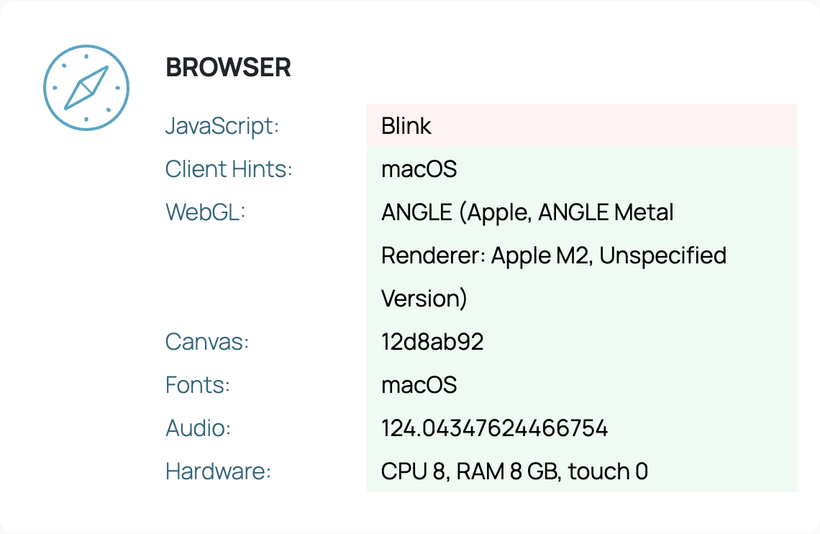
You installed an extension that changes the browser's name, and now your Chrome introduces itself as Firefox. You open Whoer, and there's a red row in the Browser card: JavaScript: Blink. The name is new, the same old Chrome is inside, and the page can tell.
A browser's name is just a string, and it's easy to rewrite. The way a browser runs the code of a page can't be rewritten. Let's see what Whoer looks at.
Three engines
An engine runs the code of a page. There are only three of them.
- Blink. Chrome, Edge, Opera, Brave and Vivaldi run on it.
- Gecko. That's Firefox.
- WebKit. That's Safari and every browser on iPhone and iPad, whatever the icon says.
How a page learns the engine
By the way the browser describes an error
Whoer triggers a harmless error on purpose and reads how the browser wrote it down. Chrome starts every line with the word at. Firefox and Safari write the function name and the @ sign, and the service fields of the error tell those two apart: each has its own.
By properties only one engine has
Chrome has an object called window.chrome on the page. Firefox has its own style property, moz-appearance. Safari has its own gesture events. Whoer asks about eight properties like these.
Then Whoer reads the User-Agent, where the browser names itself, and compares.
What the row shows
- Blink, Gecko or WebKit on green. The engine was read and it matches the browser's name.
- An engine name on red. The engine was read, and the browser's name points to another one.
- Blink + Gecko on red. The browser answers for two engines at once. That happens when a fake is only half done.
- N/A. The engine couldn't be read, or the browser names nobody.
A mismatch takes up to 20% off your anonymity score. If neighbouring checks of the same kind fired too, such as WebGL, Fonts or Browser engine by HTTP/2, Whoer treats them all as one signal and deducts once.
How this row differs from the engine by HTTP/2
The Connection card has a row called Browser engine by HTTP/2. It looks at the browser from the outside: how it put a request to the server together. The JavaScript row looks from the inside: how it runs code. Faking both at once is next to impossible. There's a separate article about the first one.
Where the other engine comes from
A spoofed User-Agent
The most common case. An extension or a setting changes the browser's name, and the engine stays the same.
A browser with someone else's profile
Some browsers can show websites the profile of a different browser. If the browser itself is built on Chromium and the profile is taken from Firefox or Safari, Blink still runs the code.
A fake that is half done
An extension painted on a couple of properties of another engine and couldn't remove its own. Then the row shows two engines at once, and that stands out most of all.
How to fix it
There is one rule: the browser has to name the engine it really runs on.
Bring the real User-Agent back
Turn off the extension or the setting that changes it. It's the simplest fix and the most reliable one.
Change the name inside your own family
Chrome can call itself Edge or Opera: they share one engine, and the row stays green. For more about the string itself see how to change the User-Agent in a browser.
Need another browser? Use it
Want to look like Firefox? Open the site in Firefox.
In a browser with profiles, pick the native engine
If the browser is built on Chromium, take a Chrome or Edge profile.
What does not help
- A proxy or a VPN. The browser runs the code, not them.
- Private mode and clearing cookies. They don't change the engine.
- A more accurate fake User-Agent. The more careful the borrowed name, the more obvious it is that another engine runs the code.
How to check the result
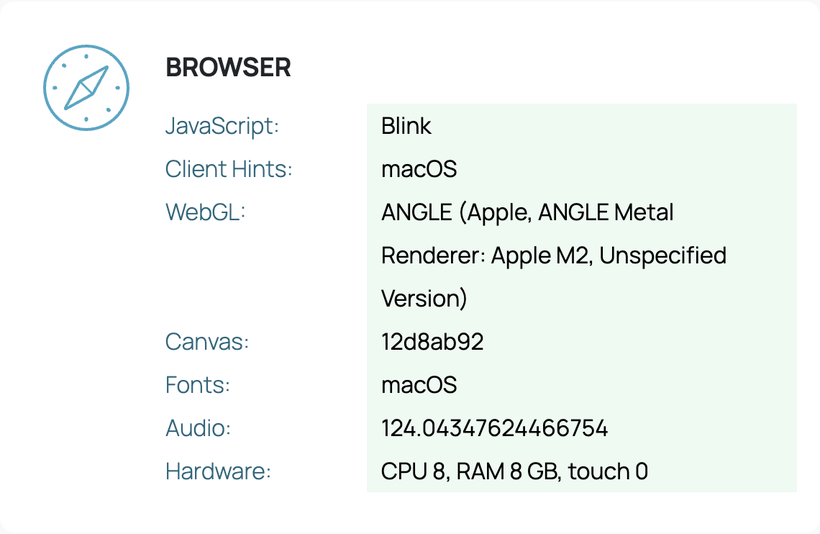
Open Whoer again and look at the Browser card. If it worked, the JavaScript row is green.
Summary
You can write any browser name you like, but the browser runs code the way it knows how.
- There are three engines: Blink, Gecko and WebKit.
- A page learns the engine from the way an error is written and from properties only that engine has.
- A mismatch usually comes from a spoofed User-Agent or a profile from another engine.
- An honest name fixes it: the real User-Agent or the name of a browser on the same engine.